
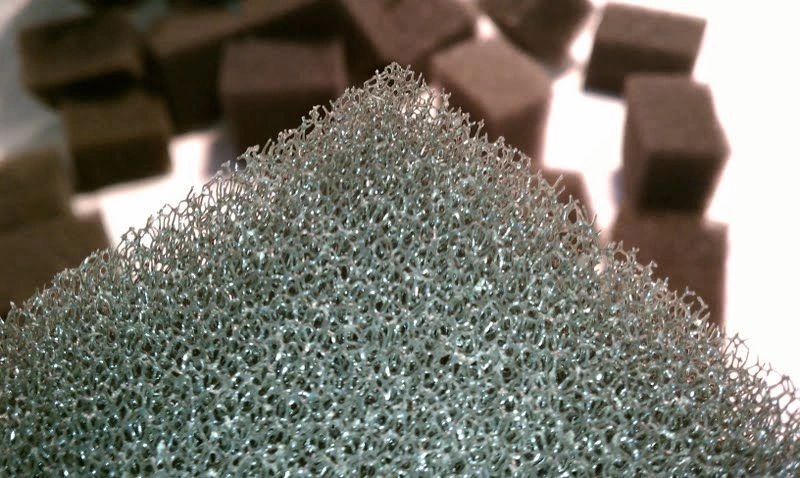
During the mid-1970’s, the USAF began experiencing electrostatic ignitions during cold weather operations on the A-10 and C-130 aircrafts. These ignitions occurred during ground re-fueling operations as well as in flight fuel/air purging and other special operations. At this time, these types of ignitions were a major concern for the USAF but there was only a limited amount of information pertaining to electrostatic generation/ignition and the behavioral relationship between reticulated polyurethane foam installed in fuel tanks in combination with hydrocarbon fuels.
During the 1980’s, the USAF assembled a team of airframe manufacturers, foam manufactures and academia to investigate the electrostatic phenomenon and find possible solutions. Extensive test programs, which included inspection of aircraft and simulations, were conducted to better understand electrostatic generation/ignition and how it related to the foam. Once a basic understanding of electrostatic generation/ignition problem was ascertained, the data was passed along to the foam manufacturers to develop a solution. This work ultimately produced a conductive polyether polyurethane foam that would greatly reduce the electrostatic generation/ignition while acting as an explosion suppressant/ignition mitigation in aircraft fuel systems.
Conductive Foam
Two types of conductive reticulated polyurethane foams were developed in the 1980’s. The first approach utilized the existing Type IV and Type V foam products and subjected them to a post-reticulation treatment to make it conductive. These foams were designated Type VI and Type VII and were utilized until the early 1990’s.
The second alternative that was developed produced and inherently conductive reticulated polyether type polyurethane foam without the post treatment. This foam became known as MIL-PRF-87260B Class 1 and Class 2 and eventually became the replacement for the Type VI and Type VII foams.
MIL-PRF-87206B polyether polyurethane foam has proven to be completely successful in the elimination of the foam electrostatic generation/ignition problem in aircraft fuel tanks. This foam is the current standard preferred choice of the US Military and is commonly referred to as explosion suppressant foam.
“In 1996 TWA Flight 800 exploded over Long Island, NY shortly after take-off from John F. Kennedy International Airport. The most likely cause of this explosion was a spark in the center fuel tank which ignited heated fuel vapor. This event prompted an industry-wide review of aircraft fuel tank safety, culminating in a series of recommendations from the Fuel Tank Harmonization Working Group (FTHWG) in 1999. Various industry-expert led teams under FTHWG produced reports outlining improvements that should be made to prevent fuel tank explosions. Reticulated polyurethane foam as an ESM was reviewed under Chapter 8 of FTHWG and found to support all the conclusions shown in Section 3.3 of this document. In addition, the use of reticulated polyurethane foam as an ESM was estimated to improve the mean-time between a fuel tank explosive event from one every five years to one approximately every fifty years – a ten-fold increase in safety performance.”
In response to this, the FAA published the Fuel Tank Flammability Rule (FTFR) and issued FAA Advisory Circular 120-98A that mandates operators of certain types of aircraft to take the necessary measures to mitigate fuel vapor ignitions. MIL-PRF-8720B Class 1 and Class 2 explosion suppressant foams meet one of the requirements set forth by the FAA for aircraft operating under 4 CFR Parts 121, 125 and 129.
KSR Foam has been fortunate to be a part of an exclusive team that has taken the explosion suppressant/reticulated foam concept and adapted it to aircraft operation under the CFR’s mentioned above. Along with various military and aftermarket projects, KSR Foam has been involved and continues to be involved with Fuel Tank Flammability Rule requirements for the following aircraft:
- Boeing 737 Classic, 737 NG, 757-200, 767-200/300 and 777-200/300
- Airbus A319, A320 and A321
Future blogs will go on to explore the benefits of explosion suppressant foam, comparisons of each type and success stories that KSR Foam has been involved in.
References
SAE AIR-4170B Reticulated Polyurethane Foam Explosion Suppression Material for Fuel Systems and Dry Bays
MIL-PRF-87206B