In the early 1960’s, the racing industry was having a problem with the rising number of accidents involving fuel explosions and fires. As speeds increased and the use of light weight materials became commonplace, the number of incidents steadily rose with the unintended consequence of fuel tanks being ruptured on impact. To combat this, the racing industry started to investigate these incidents further with the hopes of providing a feasible solution. As a result, a new crash worthy fuel tank system was designed and implemented that included the early versions of reticulated polyurethane foam.
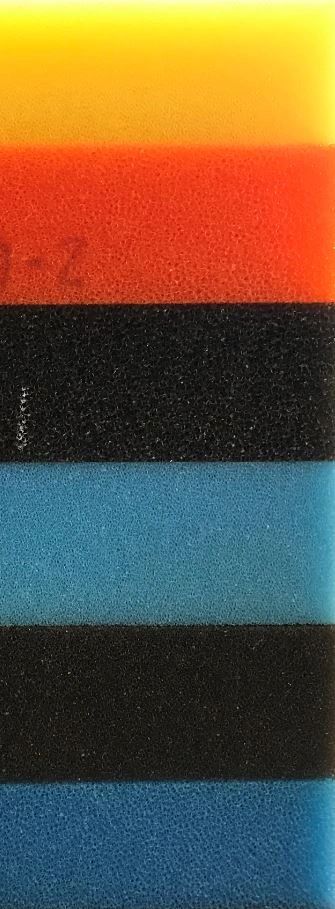
Type 1 Orange
During this same period, the Vietnam War was in full force and the USAF was seeing an increasing number of aircraft losses and pilot fatalities due to fuel tank explosions caused by small arms fire. The USAF began searching for solutions to reduce the vulnerability of the fuel tanks and improve survivability. They approached different industry providers, as well as the foam manufacturers, that have developed the reticulated polyurethane foam for the racing industry to see if this concept will work as an Explosion Suppressant Material for aircraft fuel tanks. As further research materialized, it was found that reticulated polyurethane foam was perfect solution as an explosion suppressant for aircraft and bladder fuel tanks. Type I orange reticulated foam, was introduced, and quickly accepted by the military for use in military jets, helicopters, and other aircraft.
The biggest knock on the early versions of reticulated polyurethane/explosion suppressant foam, Type I orange, was the weight and fuel penalties that accompanied the foam. Also, as more data came in, the military was made aware that this particular foam type only had an estimated life span of 5 years. However, at the time, the benefits of the reticulated polyester polyurethane foam (Type 1 orange) greatly outweighed the negative.
Type II Yellow
As time went on and more and more military applications accepted this as a significant advancement in survivability and feasibility, the USAF came back to the foam industry with a request to reduce the weight penalty. This new development effort took place in the early 1970’s and Type II, yellow reticulated polyurethane foam was introduced. While keeping the same explosion suppressant benefits of the Type I orange, the density of the Type II yellow, reticulated polyester polyurethane foam was 25% lower than the orange. With the lower weight, this allowed more fuel and munitions to be carried by the aircraft without sacrificing performance and survivability.
Type IV Dark Blue and Type V Light Blue
About the time the Type II yellow was introduced, the Vietnam war was coming to an end. Up to this point in time, most of the aircraft using the explosion suppressant foam systems where utilizing Type I orange. Since the Type I orange only had a lifespan of 5 years, the USAF was seeing a lot of degradation of the foam as it was coming to the end of its lifespan. Since the use of reticulated polyurethane foam had been such a success, the USAF again turned to the industry, but this time, to solve the degradation problem. Around the same time this request came out, the industry was starting to see revolutionary developments and breakthroughs in resins and chemicals. These breakthroughs enabled the creation of the Type IV and Type V reticulated polyether polyurethane foams and were quickly adopted into military systems. Reticulated polyether polyurethane foam offered a lifespan 5 to 10 times greatest than is predecessor with the same explosion suppressant characteristics as polyester polyurethane foam.
Up to now, all the foams Type I and Type II were reticulated polyester polyurethane foams.
All foams to this point, Type I, Type II, Type IV, and Type V were manufactured under the spec MIL-DTL-83054C.
With the widespread acceptance of these foams and the introduction of the polyether polyurethane foams, in the late 1970’s and early 1980’s, the USAF started major retrofit programs for the A-10 and C-130 aircraft to update their systems with reticulated polyether polyurethane, explosion suppressant foam. Also, implementation of the foam systems was introduced to new aircraft, such as the F-15 and F-18.
The USAF would eventually challenge the industry again to combat a new set of problems that were found as aircraft and technology became more sophisticated. To learn more about this, please visit our blog – History of Explosion Suppressant/Reticulated Polyether Polyurethane Foam (Conductive)
References
SAE AIR-4170B Reticulated Polyurethane Foam Explosion Suppression Material for Fuel Systems and Dry Bays
MIL-DTL-83054C